
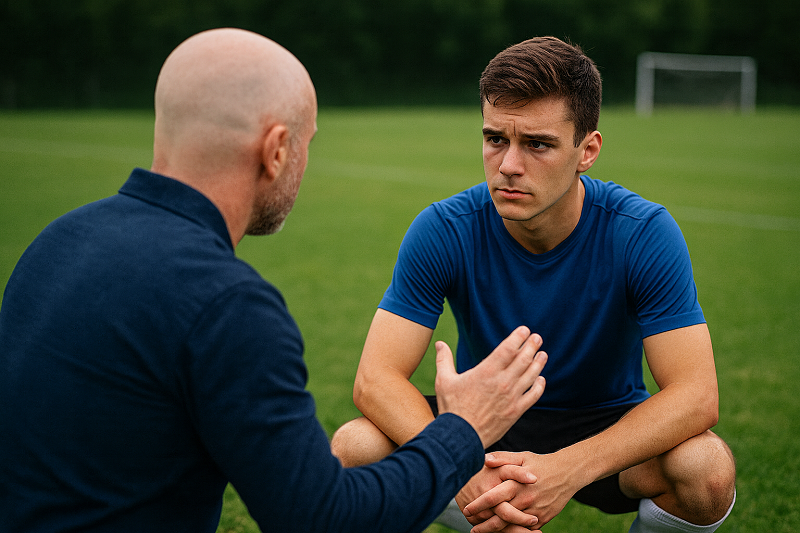
Sports Psychology and Professional Football: Supporting Young Players in Their Transition to the Elite Level
Based on an interview with Manuel Dupuis, sports psychologist specializing in the psychological support of young footballers transitioning to the professional level.
Introduction: A decisive stage in a young player’s career
The transition to professional football is a crucial moment in a young player’s development. After years spent in an academy system—often as one of the strongest in their age group—they suddenly enter an environment where competition is tougher, status shifts, and recognition is no longer automatic.
“The transition to professional football is the moment when talent must transform into high-level performance, and where the organisation around the player plays a decisive role.”
Throughout his career—including seven years at Sporting Charleroi and four years at Union Saint-Gilloise working with young talents—Manuel has supported players progressing toward elite levels. He now mainly works in private practice with players from various Belgian clubs and from abroad, including Germany, France, and occasionally England.
1. Two common profiles… among a wide variety of personalities
Young players react very differently when entering the professional world. While every athlete is unique, two recurring psychological patterns frequently appear in practice.
Profile 1: Confident, ambitious players with a strong ego — highly sensitive to frustration
Some young professionals display a high level of confidence—sometimes even a bit too much. Their ego is strong, their ambition high, and they have often been recognised for years as top performers. Their challenges mainly stem from:
- frustration when they play less than before;
- a sense of not being valued as they expected;
- irritation toward increased competition;
- a tendency to interpret or overthink staff decisions.
“These players generally have solid self-esteem. What emerges is mainly frustration from playing less or needing to prove themselves again. This creates an inner tension that needs to be managed.”
Psychological support approach
- distancing negative thoughts;
- taking perspective on frustration (and sometimes underlying anger);
- expressing emotions constructively;
- refocusing energy on training and performance when opportunities arise.
Profile 2: Highly talented players with more fragile self-esteem
Other players experience a much more destabilising transition. The loss of regular recognition can result in:
- doubts;
- decreased confidence;
- a sense of losing importance within the team;
- fluctuating motivation.
“Some players with exceptional potential quickly feel diminished when they are no longer at the centre of the project.”
Psychological support approach
- rebuilding self-esteem;
- restoring confidence;
- stabilising emotional balance;
- restarting motivation through realistic goals.
2. The essential role of feedback: a key but often underestimated factor
“The number one issue is the absence of feedback, or poorly formulated feedback. When nothing is said to a player, they interpret—usually negatively.”
Without clear communication:
- more sensitive players feel undervalued;
- more confident players feel a lack of recognition;
- tension and misunderstandings increase.
A few well-chosen words can change everything:
- “We count on you.”
- “Here’s why you’re not playing today.”
- “Your opportunity is coming.”
- “This is what you can improve.”
“Vincent Kompany is a great example of human-centred leadership. His communication and group management are outstanding: he gives young players space, speaks with them regularly, and provides clear and constructive feedback.”
3. The role of the sports psychologist: restoring confidence, calm, and motivation
A. Direct work with players
- strengthening self-esteem;
- rebuilding confidence;
- reducing negative thoughts and frustration;
- managing emotional discomfort;
- maintaining long-term motivation.
“My work is to help players express what they feel, then regain control by focusing on what they can actually influence.”
B. Indirect work with coaches
- understanding player profiles;
- adapting communication;
- formulating effective feedback;
- creating an environment that supports development.
4. A universal transition, beyond borders
“Once a player leaves the protective environment of the academy and enters a competitive professional world, everything changes.”
Conclusion: Turning potential into sustainable performance
Success in football is not based on technical ability alone. Mental balance, confidence, motivation, and the ability to adapt to a professional environment are decisive components.
“Talent is only the starting point. What truly makes the difference is psychological balance and the human environment surrounding the player.”